
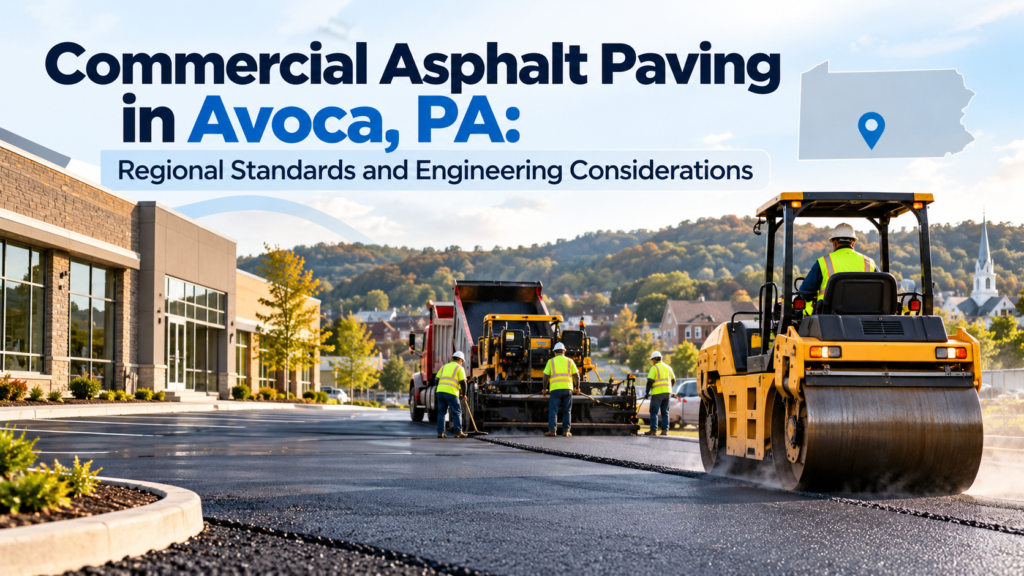
Avoca is a borough in Luzerne County, Pennsylvania, situated in the Wyoming Valley the broad floodplain carved by the Susquehanna River that runs through northeastern Pennsylvania. The region is historically rooted in anthracite coal mining and has evolved into a mixed commercial and industrial landscape anchored by Scranton Wilkes-Barre International Airport, distribution facilities, and the commercial corridors serving the greater Wyoming Valley population. Commercial Asphalt Paving Avoca in this environment must account for the specific geology, climate, and regulatory context of northeastern Pennsylvania conditions quite different from southeastern or southwestern PA.
Wyoming Valley Climate and Its Effect on Commercial Pavement
Northeastern Pennsylvania experiences one of the most demanding climates for asphalt pavement in the mid-Atlantic region. Winters in the Wyoming Valley bring sustained cold average daily lows well below freezing from December through February and significant snowfall from both frontal systems and lake-effect snow that spills over from Lake Erie to the northwest. The freeze-thaw cycle, which occurs dozens of times per season as temperatures hover near the freezing mark in shoulder months, is the dominant mechanical force acting on pavement structures in this region.
Pennsylvania’s PennDOT performance-grade binder specifications account for the region’s climate. The PG 58-28 binder rated to remain stable down to -28°C at the low end is commonly specified for pavement in northeastern Pennsylvania to resist thermal cracking during severe cold. This is a meaningfully different specification from the grades used in warmer parts of the state, and using an undersized binder grade is a common source of premature cracking in regionally inappropriate mixes.
Summer temperatures in the Wyoming Valley are moderate by mid-Atlantic standards rarely exceeding the 90s which means rutting from softened binder is less of a concern here than in southern Pennsylvania or New Jersey. The focus in this climate is overwhelmingly on cold-temperature performance.
Anthracite Mining Legacy and Subsurface Conditions
The geological history of the Wyoming Valley has left a subsurface that requires particular attention in commercial paving projects. Decades of deep anthracite coal mining created an extensive network of tunnels and voids beneath much of Luzerne County, and in areas where old workings exist near the surface, ground subsidence remains a risk. Areas near historic mine entries and slope portals many of which are visible throughout communities like Avoca should be investigated before significant site grading or foundation work associated with paving projects.
Pennsylvania’s Department of Environmental Protection oversees the Office of Active and Abandoned Mine Operations (AAMO), which maintains mapping resources for mine workings throughout the anthracite coal region. Consulting these resources and, where appropriate, engaging a licensed geotechnical engineer familiar with mine subsidence risks is prudent for commercial development projects in the Wyoming Valley.
Even where deep mining voids are not a concern, the surface soils of the Wyoming Valley often include disturbed fill from historic industrial and mining operations, alluvial deposits from the Susquehanna River floodplain, and variable residual soils overlying bedrock. Subsurface investigation through test borings is standard practice for commercial paving design in this area.
PennDOT Standards and Commercial Paving in Pennsylvania
Pennsylvania’s commercial paving projects particularly those adjacent to or connecting with state-maintained roads are governed by PennDOT Publication 408, the standard specification for road and bridge construction that covers material requirements, construction methods, and testing procedures. Even for private commercial lots, Publication 408 specifications are widely adopted by contractors and engineers in the Commonwealth as the baseline quality standard.
PennDOT Publication 72M provides roadway construction standards including driveway and access permits. Any commercial paving project that creates or modifies a connection to a state highway requires a Highway Occupancy Permit (HOP) from the applicable PennDOT district in Luzerne County, District 4-0 (Dunmore). The HOP process involves plan submission, review, and approval before construction begins.
Pennsylvania’s contractor licensing requirements under the Home Improvement Consumer Protection Act (HICPA) apply to certain residential projects, but for commercial projects, licensing requirements vary by municipality. Avoca Borough and Luzerne County have their own permitting requirements for commercial construction and grading work.
Stormwater Management in the Wyoming Valley
Pennsylvania’s stormwater regulations, implemented through the Pennsylvania Stormwater Management Act (Act 167 of 1978) and the Clean Streams Law, require that stormwater management plans address runoff from new and redeveloped impervious surfaces. Luzerne County’s Act 167 Stormwater Management Plan, adopted by individual municipalities, provides standards for post-construction stormwater controls in commercial developments.
The Susquehanna River and its tributaries running through the Wyoming Valley are subject to FEMA flood mapping, and many commercial parcels in and around Avoca lie within or adjacent to floodplain zones that impose additional regulatory requirements on grading and drainage design. Luzerne County Conservation District provides erosion and sedimentation control plan review and is the responsible authority for NPDES permits for earth disturbance in the county.
Subsurface Drainage and Base Design for Commercial Lots
In northeastern Pennsylvania’s wet climate, subsurface drainage is a critical element of commercial pavement design. Water trapped in the aggregate base weakens its bearing capacity and, when subjected to freeze-thaw cycling, causes accelerated base deterioration. Perforated underdrain systems typically 4-inch perforated HDPE pipe in aggregate-filled trenches along lot perimeters and at low points in the lot can significantly extend pavement life by removing excess moisture from the base course.
Open-graded aggregate base, which drains freely rather than holding water in finer-particle voids, is increasingly specified in northeastern Pennsylvania commercial lots precisely because it promotes rapid drainage of infiltrated water. The free-draining base must be connected to an outlet typically an underdrain to a catch basin or daylight outlet to function as intended.
Frequently Asked Questions: Commercial Asphalt Paving in Avoca
What is PennDOT Publication 408 and does it apply to private commercial lots?
Publication 408 is PennDOT’s standard specification document for construction materials and methods. It directly governs state highway construction and projects within the public right-of-way. For private commercial lots, it is not legally required, but it is widely used as the quality baseline because it represents established regional practice and many engineers specify it as the reference standard in private project specifications.
How does freeze-thaw damage appear in commercial pavement?
Freeze-thaw damage typically presents as longitudinal and transverse cracking, followed by spalling where the surface material dislodges along crack faces. In base courses, freeze-thaw can cause frost heave the upward displacement of the pavement as freezing water expands beneath it which is visible as ridges or uneven surface elevation. Frost heave in commercial lots is particularly damaging at curb and drain transitions where elevation changes concentrate stress.
Are there special requirements for commercial paving near the Scranton Wilkes-Barre Airport?
Paving projects within the airport influence area may be subject to FAA height restriction review for any equipment or temporary structures used during construction, particularly tall equipment like paving plant conveyors or cranes. The airport’s Part 77 airspace surfaces define these zones. Most standard commercial paving operations do not involve equipment approaching restricted heights, but awareness of this context is appropriate for large projects near the airport corridor.
What is the typical base course depth for commercial lots in northeastern Pennsylvania?
Given the freeze-thaw exposure and variable subsoils of the Wyoming Valley, commercial lots in the Avoca area typically include 8 to 12 inches of compacted aggregate base beneath 3 to 5 inches of asphalt, with the specific section determined by a pavement design process accounting for subgrade CBR, projected traffic, and climate conditions.